
Last updated September 25, 2026
Non-destructive entry first, always - and we re-key Schlage, Kwikset, and Baldwin locks on the spot while you watch
You get a price before we start. It does not change when we arrive. No surprises.
Locksmith Permits, Codes & Inspections in NY: What You Need to Know
Installing a high-security deadbolt on a fire-rated apartment door without understanding NYC Building Code Section 1008 can result in a violation that the next owner inherits. In Manhattan, where pre-war co-ops, post-war condos, and commercial conversions sit side by side, the rules governing what you can change on a door, and who must approve it, shift block by block. Most residents assume a locksmith can swap any lock without consequence. That assumption is wrong for roughly 30% of the jobs we survey in Manhattan, and the liability falls on the property owner, not the installer, when the work is done without proper filing.
Quick Answer
Most residential lock replacements inside a Manhattan apartment do not require a permit. However, any work on a fire-rated door assembly, building entry systems in multiple dwellings, or ADA-regulated commercial entrances must comply with NYC Building Code, Multiple Dwelling Law, or DOB filing requirements. An unpermitted installation on a fire-rated door voids the assembly’s certification and creates a transferable violation.
Table of Contents

- Which Lock Jobs in NYC Require a DOB Permit?
- Homeowner Exemptions: Where the Line Actually Falls
- NYC Multiple Dwelling Law: What Landlords Must Maintain, What Tenants Can Change
- Fire-Rated Door Hardware: Why the Lock, Closer, and Strike Must Match
- ADA Compliance in Commercial and Mixed-Use Buildings
- How to Request Code-Compliance Documentation From Your Locksmith
- Common Mistakes to Avoid
- When to Call a Professional
- Frequently Asked Questions
- The Bottom Line
Which Lock Jobs in NYC Require a DOB Permit?
The New York City Department of Buildings does not issue permits for “locksmith work” as a category. What triggers filing requirements is the type of door, the building classification, and whether the alteration affects life safety or accessibility systems.
Here are the specific scenarios where a permit or professional certification is required:
- Fire-rated door assemblies in Group R-2 occupancies. Most Manhattan apartment buildings fall under Group R-2. Any modification to a fire-rated door, including lock replacement, requires that the new hardware maintain the assembly’s listed rating. The work itself may not need a standalone permit, but the building’s Certificate of Occupancy or filed plans must reflect compliant hardware. In practice, this means the installing locksmith must provide documentation proving the new lock is rated for that specific door.
- Building entry doors in multiple dwellings. Under the NYC Multiple Dwelling Law, the main entry door of a building with three or more units must have a self-closing and self-locking mechanism. Replacement of this system typically requires filing with the DOB if the building’s Certificate of Occupancy specifies the hardware type.
- Commercial storefront alterations. Changing the lock on a commercial door rarely triggers permitting. Changing the door itself, the panic hardware, or the access control system integrated with fire alarm systems may require a Type 1 or Type 2 permit depending on occupancy classification.
- ADA-triggering alterations. In commercial buildings and mixed-use structures, any alteration to a primary entrance that costs more than a defined threshold (historically tied to the cost of full compliance) triggers a requirement to bring the entire entrance into ADA compliance. This includes lever handle geometry, operating force, and clear opening width.
- Landmark and historic district properties. Manhattan’s Upper West Side, Greenwich Village, and parts of the Financial District fall within LPC-designated historic districts. Exterior door hardware changes visible from the street require Landmarks Preservation Commission approval, separate from DOB requirements.
In our experience surveying jobs across Manhattan, from pre-war walk-ups in the East Village to high-rise condos in Battery Park City, the most common permit-triggering scenario is the fire-rated apartment door. Residents purchase a Medeco or Mul-T-Lock deadbolt for security, unaware that their 90-minute rated door requires hardware tested to UL 10C or NFPA 252 standards. The lock functions perfectly. The door no longer meets code.
Homeowner Exemptions: Where the Line Actually Falls
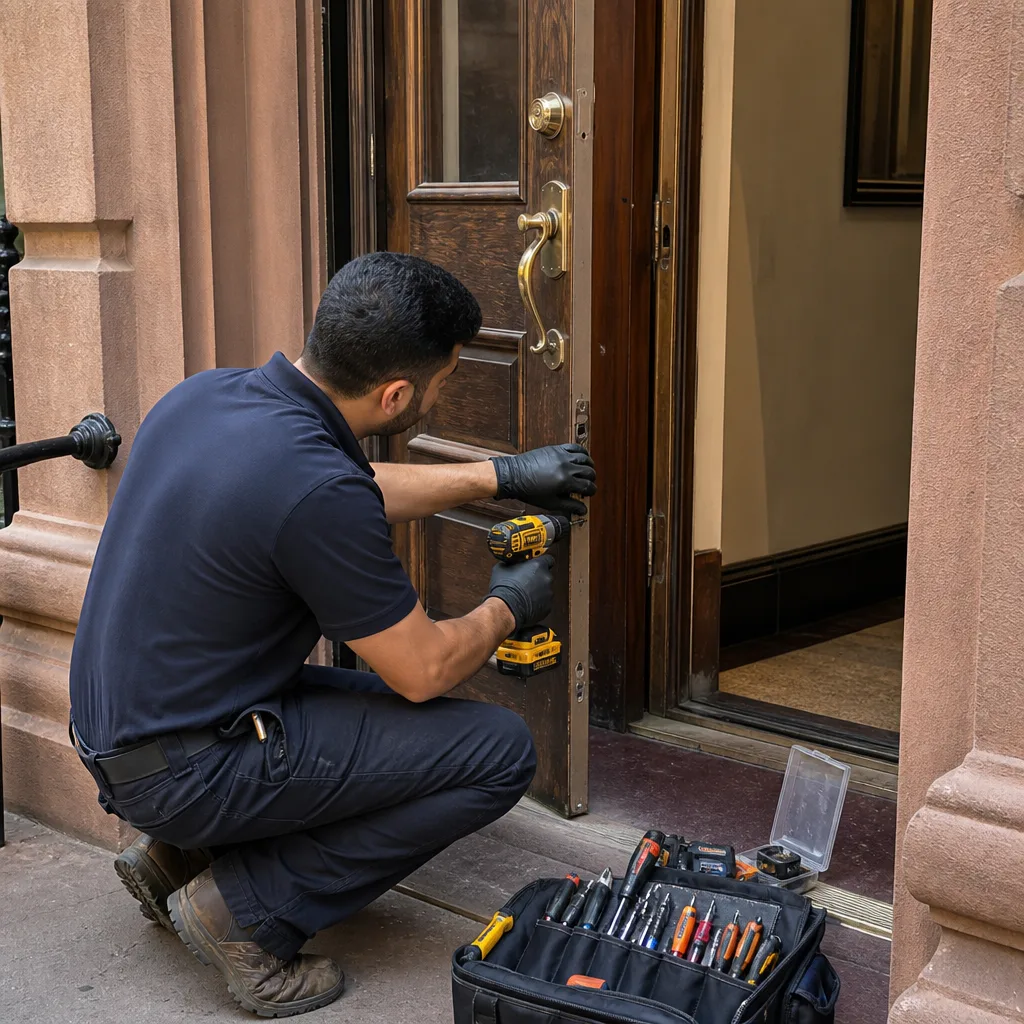
The exemption for homeowner-performed work is narrower in New York City than in most of the country. NYC Administrative Code and DOB guidelines limit unlicensed work to minor repairs and replacements that do not affect structural, mechanical, electrical, or life safety systems.
For locks specifically, the following are generally exempt from permitting:
- Interior door lock replacement on non-fire-rated doors within a single residential unit
- Rekeying of existing cylinders, provided no hardware is replaced
- Installation of portable or surface-mounted locking devices (chain locks, sliding bolts) on interior doors
- Lock replacement on private house doors, provided the door is not fire-rated and the house is not a multiple dwelling
What is not exempt, and where we see the most confusion:
- Any lock on a door labeled with a fire rating (typically a metal tag on the hinge edge reading “20 MIN,” “45 MIN,” “90 MIN,” or similar)
- Building entry doors in co-op and condo buildings, where the alteration may affect common-area fire separation
- Locks on doors serving as required means of egress, where the new hardware must comply with NYC Building Code Section 1008 on egress door operation
The critical distinction: the exemption applies to the work, not the person. A licensed locksmith performing an exempt lock change does not need a permit. An unlicensed handyman performing non-exempt work on a fire-rated door commits a violation regardless of permit status. The liability, however, attaches to the property owner.
In Manhattan’s co-op market, this distinction matters at resale. Board packages routinely require disclosure of alterations. A lock change on a fire-rated door without compliant documentation can delay closing or trigger a required remediation at the seller’s expense.
NYC Multiple Dwelling Law: What Landlords Must Maintain, What Tenants Can Change
The New York City Multiple Dwelling Law, Article 3, Section 58, establishes specific requirements for locks in buildings with three or more dwelling units. These rules create a baseline that landlords must meet and a boundary that tenants cannot cross without permission.
What landlords must provide:
- A main entry door with a self-closing mechanism and a locking device that engages automatically when the door closes.
- Individual apartment door locks with a heavy-duty deadbolt and a doorknob lock, both operable from the inside without a key (single-cylinder operation).
- Peepholes or door viewers on apartment doors installed after 1968.
- Window guards on certain windows, though this falls outside locksmith work.
What tenants may legally change:
A tenant may install an additional lock on their apartment door, provided it meets three conditions: it must be installed without damaging the door or frame beyond normal wear; it must be removable without permanent alteration; and it must not impede egress or violate fire code. The classic example is a surface-mounted slide bolt or chain lock.
What tenants may not change without landlord consent:
Replacing the primary lock cylinder or deadbolt on an apartment door technically requires landlord approval in most Manhattan rental buildings, though this is rarely enforced for like-for-like replacements. Changing to a different lock type, such as installing a double-cylinder deadbolt (which requires a key to exit), is prohibited under MDL Section 58 because it impedes egress. Installing smart locks that modify the door’s fire rating or fail to meet the self-closing requirement on building entry doors is also prohibited.
For residential locksmith work in Manhattan, we routinely encounter tenants who installed non-compliant hardware and must restore the original condition at move-out. We document the existing hardware with photographs before any work begins, providing both tenant and landlord with a dated record of the door’s condition and hardware specifications.
Fire-Rated Door Hardware: Why the Lock, Closer, and Strike Must Match
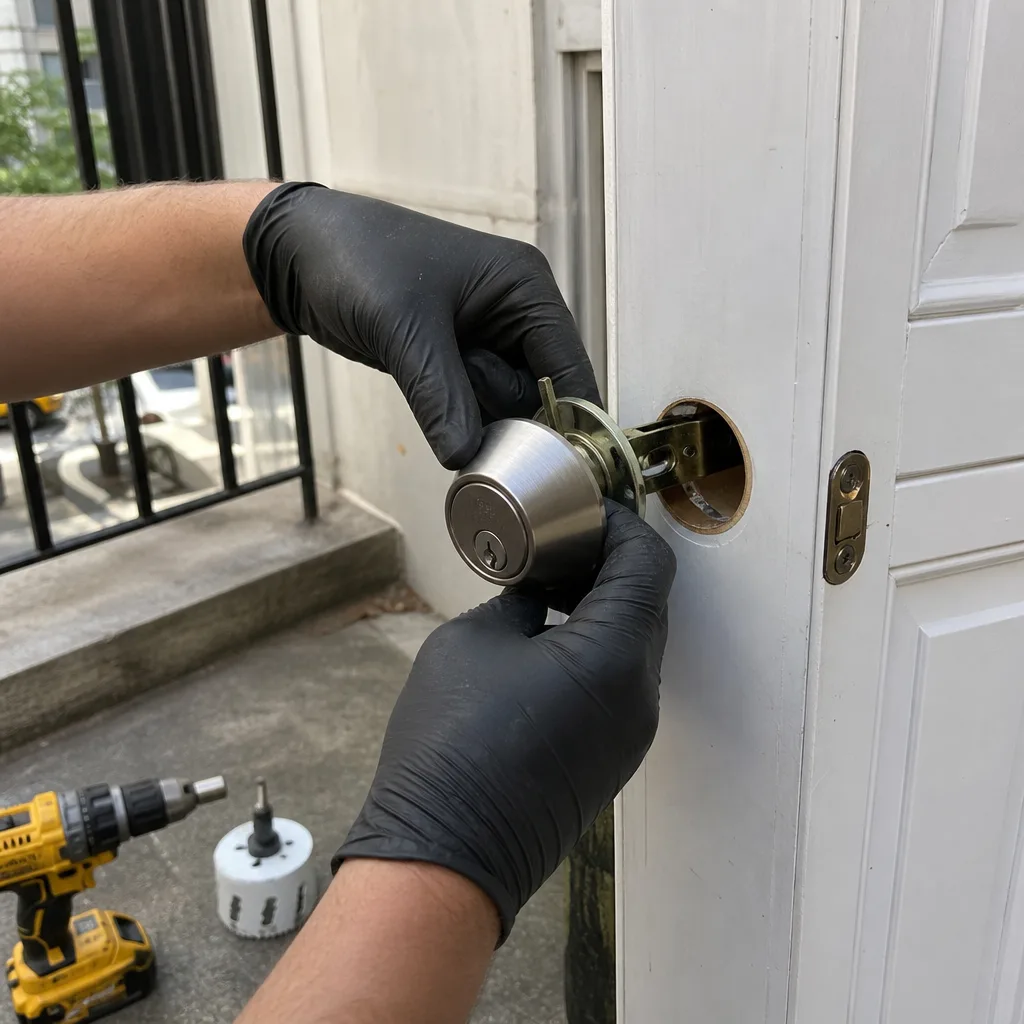
A fire-rated door is tested and certified as an assembly. The door slab, the frame, the hinges, the lock or latch, the closer, the strike plate, and any glazing are tested together under specific standards (UL 10B, UL 10C, or NFPA 252 for positive pressure). Substituting any component with an untested alternative voids the assembly’s rating.
This is the technical reality that most Manhattan residents, and some locksmiths, do not understand. The deadbolt you purchased at a hardware store may be an excellent lock. It may be a Schlage Grade 1 commercial deadbolt with a 1-inch throw. If it has not been tested and listed as part of that specific door assembly, the door is no longer fire-rated.
What the rating label tells you:
Fire-rated doors in Manhattan buildings typically bear a label on the hinge edge indicating the rating period (20, 45, 60, 90 minutes) and the certifying body (UL, Warnock Hersey, Intertek). The label may also list specific hardware by manufacturer and model that was tested with that door. When we survey a job, we photograph this label before recommending any hardware change.
The three components that must stay matched:
- The lock or latch. Must be listed for use on fire doors of that rating period. Look for the fire door symbol on the packaging or specification sheet. Grade 1 or Grade 2 status from BHMA/ANSI does not automatically mean fire-rated.
- The closer. Surface-mounted, concealed, or floor closers must be listed for the door’s rating period and installed with the exact mounting geometry tested (regular arm, parallel arm, top jamb).
- The strike plate. The strike must be the model tested with the lock and door. Substituting a generic strike, or enlarging the strike mortise, can compromise the door’s ability to withstand fire exposure at the latch location.
In Manhattan’s older stock, particularly pre-war buildings on the Upper East Side and in Morningside Heights, we frequently encounter doors where the original closer was removed for convenience and the lock was replaced with a non-rated alternative, often due to overlooked seasonal locksmith care. The door looks correct. The label may still be attached. The assembly is not compliant. When we document these conditions, we provide a written scope noting the specific code violation and the rated hardware required to restore compliance.
For commercial locksmith services in Manhattan, this issue is more acute. Commercial occupancies have more frequent fire inspections, and a failed inspection due to non-compliant door hardware can result in fines and occupancy restrictions.
ADA Compliance in Commercial and Mixed-Use Buildings
The Americans with Disabilities Act and its NYC local equivalent, the NYC Human Rights Law accessibility provisions, establish specific requirements for door hardware in public and common-use areas. In Manhattan, where commercial storefronts, residential lobbies, and mixed-use buildings overlap on single blocks, ADA compliance is not a distant concern for specialized buildings. It is a routine consideration for lock work.
Hardware requirements that affect locksmith selection:
- Lever handles required. Knob-operated locks are prohibited on accessible doors. The operating mechanism must be a lever, push-type, or other shape operable with a closed fist.
- Operating force limited. The maximum force to operate the latch is 5 pounds. Many high-security deadbolts and mortise locks exceed this force when new or when poorly maintained.
- Clear opening width. The door must provide 32 inches of clear width when open 90 degrees. Lock hardware projection into the opening cannot reduce this dimension.
- Threshold and surface transitions. While not strictly lock hardware, the complete assembly including weatherstripping and thresholds must not exceed specified height limits.
When lock replacement triggers full compliance review:
Under ADA Standards for Accessible Design, an “alteration” to a primary function area that costs more than a defined threshold triggers a “path of travel” requirement. In practice, this means that replacing the lock on a commercial entrance may require concurrent review of the door’s operating force, the presence of accessible hardware, and the clear opening width. A simple lock change becomes a compliance project.
We address this in our written scopes for access control systems in Manhattan by specifying ADA-compliant lever handles, electric strikes with appropriate operating force, and panic hardware with touch-pad or cross-bar operation where required. The specification sheet includes the ANSI/BHMA grade, the UL fire rating if applicable, and the operating force in pounds.
In Manhattan’s commercial corridors, from the Garment District to the Flatiron, we have replaced non-compliant knob sets with ADA levers on buildings that received ADA complaints, following our Commercial Locksmith Maintenance Checklist for Manhattan Homeowners. The hardware change is straightforward. The documentation proving compliance is what protects the building owner from subsequent claims.
How to Request Code-Compliance Documentation From Your Locksmith

The minimum acceptable record for any lock installation that may fall under code requirements is a signed work order with specific part numbers, manufacturer specifications, and a statement of compliance. Most locksmiths do not provide this as standard practice. You must request it, and you should refuse work from any provider who cannot or will not produce it.
What to request and when:
- Before work begins: A written scope describing the existing hardware, the proposed replacement, and the applicable code standard (NYC Building Code Section 1008, MDL Section 58, ADA Standards section, or LPC guidelines for historic properties). The scope should include manufacturer name, model number, and finish for every component.
- At completion: A signed work order or invoice listing the installed hardware by part number, with a statement that the installation complies with the specified standard. For fire-rated doors, request the manufacturer’s specification sheet showing the fire rating.
- Photographic documentation: Dated photographs of the installed hardware, the fire rating label on the door edge, and any visible code markings. At Novak Lock & Security Manhattan, we provide this as standard procedure under The Haven Standard, not as an upgrade.
- Warranty and follow-up: A written warranty specifying coverage period and response procedure. Our 365-Day Done Right Promise applies to all installations; Haven Standard Clause 1 requires that the quoted price is the invoiced price with no additions.
Red flags that indicate inadequate documentation:
- Invoice lists only “install deadbolt” without manufacturer or model
- Locksmith cannot identify whether the door is fire-rated
- No photograph of the door label or installed hardware
- Verbal assurance of compliance without written specification
- Price quoted changes at the door (direct violation of Haven Standard Clause 1)
We have reviewed competitor estimates for Manhattan properties where the quoted lock was a residential-grade Kwikset deadbolt proposed for a 90-minute fire-rated commercial door. The customer was not informed of the incompatibility. Our free second opinion identified the correct rated hardware and the code violation in the original proposal. The written scope we provided listed the Schlage or Medeco fire-rated equivalent, the matching strike, and the specification sheet reference.
Common Mistakes to Avoid
- Assuming all deadbolts are equal for fire doors. A Grade 1 deadbolt is not automatically fire-rated. The packaging must display the fire door symbol and list the specific rating period. We have replaced incorrectly installed deadbolts in Manhattan co-ops where the board’s engineer flagged the violation during resale inspection.
- Installing double-cylinder deadbolts in rental units. MDL Section 58 prohibits locks that require a key to exit from the inside. A tenant installation of a double-cylinder lock is a code violation and a life safety hazard. Landlords can require removal and charge restoration costs.
- Removing door closers on building entry doors. The self-closing requirement is not optional. Removing a closer to eliminate slamming, without replacing it with a properly adjusted compliant closer, violates the Multiple Dwelling Law and creates fire separation gaps.
- Ignoring LPC review in historic districts. In Greenwich Village and the Carnegie Hill historic districts, we have seen owners fined for installing modern hardware visible from the street without LPC approval. The lock may be excellent. The installation is illegal.
- Accepting verbal compliance claims. A locksmith who says “it’s fine” without providing a specification sheet is not offering protection. The violation survives the installation and transfers with the property. Written documentation is the only defensible record.
- Choosing hardware based on online reviews without code verification. A smart lock with excellent consumer ratings may lack fire rating, ADA lever compliance, or NYC electrical approval. The review does not determine code compliance. The specification sheet does.
When to Call a Professional
Call a licensed locksmith when the door is fire-rated, serves as a required means of egress, is part of a multiple dwelling entry system, or is in a commercial or mixed-use building with ADA exposure. Call when you are uncertain of the door’s rating, when the building is a co-op or condo with alteration agreement requirements, or when the property is in a historic district.
Do not attempt to modify fire-rated hardware yourself. The assembly certification depends on tested configurations. An incorrect installation voids the rating and may invalidate insurance coverage in a fire loss.
Novak Lock & Security Manhattan offers free estimates in Manhattan. We provide a written scope before any work begins, with specific part numbers and code references. Every installation is documented with photographs and backed by our 365-Day Done Right Promise. Call (862) 319-3759 to schedule a survey.
Frequently Asked Questions
No, if the door is not fire-rated and the replacement is a like-for-like single-cylinder lock. Yes, if the door is fire-rated, in which case the new hardware must maintain the assembly’s certification and documentation should be provided. Call (862) 319-3759 for a free estimate if you are uncertain about your door’s rating.
Check the hinge edge of the door for a metal or paper label indicating a rating period (20, 45, 60, 90 minutes) and a certifying body such as UL, Warnock Hersey, or Intertek. Fire-rated doors in Manhattan buildings are typically metal or mineral-core wood. A solid wood door without a label is likely not rated.
Yes, if the smart lock modifies the door’s fire rating, impedes egress, or alters the common-area building entry system. Most Manhattan lease agreements require landlord approval for lock changes. Even where not enforced, non-compliant installations can trigger restoration requirements at move-out.
The door assembly loses its certification. In a fire, the door may fail to perform as designed. In a real estate transaction, the condition may be flagged by a building engineer or inspector, requiring replacement before closing. The property owner bears the liability, not the locksmith who performed the installation.
Yes, if the space is open to the public or serves as a primary function area in a commercial building. ADA requirements for door hardware apply regardless of business size. A lock replacement that exceeds the alteration cost threshold triggers a full path-of-travel compliance review.
At Novak Lock & Security Manhattan, yes. Haven Standard Clause 1 requires that the price quoted on the phone is the price on the invoice. The technician is not permitted to change it at the door. This rule has been in place since 2002. Written confirmation is provided before dispatch.
The Bottom Line
Locksmith permits in New York City are not about the lock itself. They are about the door, the building classification, and the life safety or accessibility standards that the assembly must maintain. The line between exempt homeowner work and regulated alteration is narrower than most Manhattan residents assume. Fire-rated doors, multiple dwelling entries, and commercial ADA-regulated entrances require specific hardware, specific documentation, and specific expertise. An unrecorded installation on the wrong door creates a violation that transfers with the property. The protection is not in the quality of the lock. It is in the written scope, the specification sheet, and the photograph that proves what was installed and why it complies.
Written by Daniel Novak, Owner at Novak Lock & Security Manhattan, serving Manhattan since 2002.