
Last updated September 25, 2026
Non-destructive entry first, always - and we re-key Schlage, Kwikset, and Baldwin locks on the spot while you watch
You get a price before we start. It does not change when we arrive. No surprises.
Commercial Locksmith Maintenance Checklist for Manhattan Homeowners
A single worn-out door closer on a commercial entry can void a building’s fire egress compliance - yet most commercial tenants in Manhattan have never had their hardware inspected since move-in. In a city where a ground-floor retail space might see 500 entries per day and a residential brownstone sees 20, the maintenance schedule that protects a homeowner means almost nothing to a small business owner or building manager. This guide - alongside our Complete Guide to Locksmith in Manhattan - is built for commercial realities: high-traffic hardware, NYC code requirements, master key accountability, and the documentation that holds up in court or with your insurer.
Quick Answer
Commercial locksmith maintenance in Manhattan should happen quarterly for high-traffic entries and annually for all other hardware. The core tasks are: inspecting door closers, panic bars, and self-closing mechanisms for code compliance; testing electronic access control battery backups and audit logs; auditing master key issuance and rekeying after employee turnover; and documenting everything in writing with dated photo records. Most Manhattan businesses skip the documentation step - and that’s where liability exposure lives.
Table of Contents

- Quarterly vs. Annual Inspection Intervals
- NYC Local Law Requirements for Commercial Door Hardware
- Master Key System Audits and Rekeying Protocols
- Electronic Access Control Maintenance Tasks
- Documentation Standards for Insurance and Liability
- What Commercial Lock Maintenance Costs in Manhattan
- Common Mistakes to Avoid
- When to Call a Professional
- Frequently Asked Questions
Quarterly vs. Annual Inspection Intervals
Not all commercial hardware ages at the same rate. In Manhattan, where a SoHo boutique’s front door and a Midtown office building’s service entrance see radically different use patterns, the inspection calendar should reflect actual cycles, not a generic annual reminder.
Quarterly inspection threshold: Any door averaging 50+ entries per day, any hardware exposed to weather (street-level entries with wind-driven rain and freeze-thaw), and any door required for fire egress on a floor occupied by 50+ people. In our experience at Commercial Locksmith in Manhattan, the spring and fall quarters show the highest failure rates - March-April as winter salt corrosion manifests, and September-October as summer humidity swelling causes latch misalignment.
Annual inspection threshold: Interior office doors, storage rooms, and secondary access points below 50 daily cycles. These still matter: a failed interior lock on a server room or records storage creates operational disruption even if it doesn’t trigger a code violation.
Here’s how we break down the inspection tasks by interval:
Quarterly Tasks (High-Traffic / Egress / Exterior)
- Test door closer closing speed and latch engagement - 3-7 seconds from 90 degrees to closed per ANSI A156.4
- Inspect panic bar touchpad for cracks, corrosion, or binding; verify single-motion release
- Check hinge screws and pivot points for loosening from vibration; tighten or replace stripped fasteners
- Examine weatherstripping and door bottom seals; replace if compressed or torn (prevents frame rust and lock corrosion)
- Test key override on all panic hardware; verify cylinder turns smoothly without excessive force
- Lubricate latch bolts and deadbolts with dry graphite (not oil-based, which attracts grit)
Annual Tasks (All Commercial Hardware)
- Remove and inspect strike plates for wear patterns indicating latch misalignment
- Check lock cylinder for wobble or looseness in the escutcheon
- Test all keys for smooth operation; identify and replace worn or bent keys before they break off
- Verify door frame integrity - wood frames in pre-war Manhattan buildings compress and shift
- Review hardware grade against current occupancy and insurance requirements
We’ve replaced Grade 2 residential hardware on commercial doors in the Flatiron District where the owner didn’t know the difference. Grade 1 commercial hardware costs more upfront and lasts 5-8 times longer under commercial load. The wrong grade is a false economy.
NYC Local Law Requirements for Commercial Door Hardware
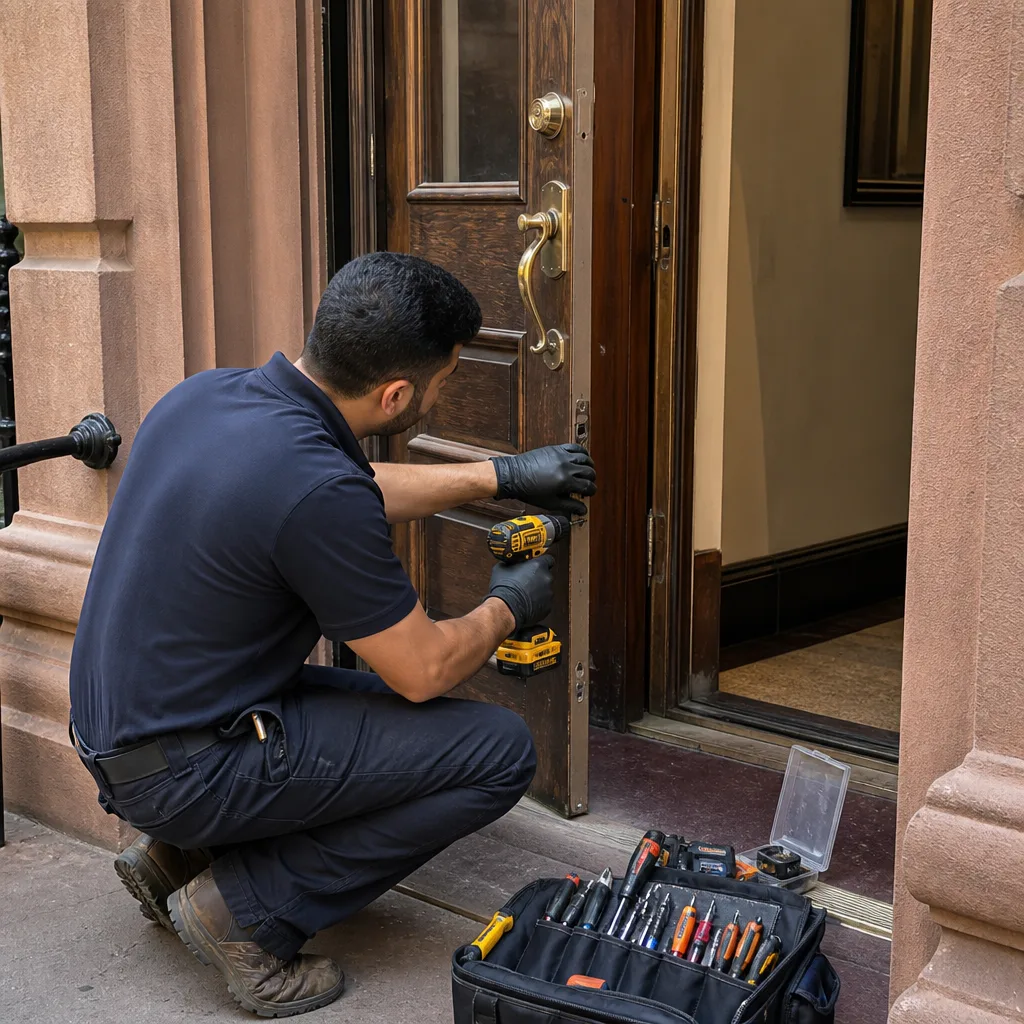
Manhattan commercial tenants operate under a stack of codes that residential owners rarely encounter. Three Local Law provisions directly affect your door hardware, and ignorance doesn’t shield you from fines or liability.
Local Law 58/1987 (ADA Compliance): All public entrances and common areas must have lever-style handles, not knobs, and operable with one hand without tight grasping. We’ve found non-compliant hardware still in service in older buildings from the Upper West Side to the Financial District - usually installed by a previous tenant who never updated. The lever must return to within 1/2 inch of the face of the door. A stiff or sagging lever is a violation waiting for an inspector.
Local Law 26/2004 (Fire Safety and Egress): Requires panic bars on all commercial occupancies with 50+ persons, and mandates that exit doors remain unlocked during business hours. The self-closing mechanism must be functional - a propped-open fire door is a Class 1 violation. In Manhattan’s dense commercial corridors, FDNY inspectors conduct spot checks, particularly in buildings with restaurant or retail occupancy on the ground floor.
Local Law 141/2013 (Energy Conservation): Requires self-closing doors on all conditioned spaces. This overlaps with fire code but adds a separate enforcement channel through the Department of Buildings. A failed door closer in a climate-controlled office is now two violations.
The inspection triggers that matter: change of occupancy (new tenant, new use), certificate of occupancy renewal, and complaint-driven FDNY or DOB inspections. After a fire or security incident, investigators will examine hardware maintenance records. “We didn’t know” doesn’t appear in the violation dismissal code.
For buildings with Access Control Systems in Manhattan, the electronic release on a fire-rated door must fail-safe (unlock on power loss) and integrate with the fire alarm panel. We’ve corrected multiple installations where the access control was wired fail-secure - locking occupants in during a fire alarm. That’s not a maintenance issue; that’s a life safety emergency.
Master Key System Audits and Rekeying Protocols
A master key system in a Manhattan commercial building is a hierarchy of access that decays over time. Every departing employee with a key, every lost key unreported, every unauthorized copy made at a corner key shop erodes the system’s integrity. We audit these systems in buildings from Tribeca to East Harlem, and the pattern is consistent: the older the system, the more keys exist than the owner knows about.
The audit protocol we follow:
- Inventory all key blanks by serial number and bitting code against the original key schedule
- Identify any keys not accounted for - marked “missing,” “lost,” or never returned
- Inspect key bows for unauthorized duplication marks (many key shops stamp their identifier)
- Interview building management about turnover since last audit; any gap over 18 months suggests unrecorded changes
- Photograph each cylinder and its keyway for the documented record
- Generate a written key schedule showing: master, sub-master, and change keys with assigned holders
Rekeying triggers: Any unaccounted key, any key held by a terminated employee, any indication of unauthorized duplication, and any cylinder showing pick marks or impressioning damage. In Manhattan’s competitive commercial environment, employee turnover averages 18-24 months in retail and hospitality. We recommend rekeying on a schedule tied to turnover, not calendar date.
The cost to rekey a commercial cylinder in Manhattan typically runs $45-$85 per lock, quoted in writing before we start. A full master key system rekey for a 20-door building runs $1,200-$2,400 depending on cylinder type and key quantity. High-security cylinders from Medeco or Mul-T-Lock require factory-authorized key control and cost more, but they cannot be duplicated without authorization - the security gain is measurable.
We leave every audit with a dated photo record and a written key schedule. Haven Standard Clause 4 requires both. Verbal confirmation from a technician that “everything looks fine” is not a record; it’s a liability gap.
Electronic Access Control Maintenance Tasks

Electronic access control in Manhattan buildings - card readers, keypads, biometric units, and the controllers behind them - requires maintenance that most property managers never schedule. The hardware looks clean on the wall, but the failure modes are invisible until they strand an employee or lock out a delivery.
Battery backup testing: Every access control panel has a 12V or 24V battery backup for power failure. These batteries sulfate and fail in 3-5 years, faster in Manhattan’s temperature-swung utility rooms. We test under load, not with a voltmeter - a battery showing 12.6V open-circuit can collapse to 8V when the strike releases. The test is: remove AC power, verify the system operates for 4 hours or per manufacturer spec, and document the result. Replacement batteries cost $80-$150; a failed backup during an outage costs the business whatever the door protects.
Audit log review: The access control database records every entry, every denied credential, every forced-door alarm. Most systems retain 90 days by default. We review for: credentials used outside normal hours (indicates sharing or theft), repeated denied entries (possible credential cloning attempt), and doors held open beyond timeout (propped doors, failed closers). In a Manhattan retail building we service near Herald Square, audit log review caught a terminated employee’s credential still active three months after departure - the property manager had updated payroll but not the access system.
Credential deactivation protocols: Every termination, every lost card, every contractor completion should trigger immediate deactivation. The protocol should be written, assigned to a specific person, and tested quarterly. We find the gap between HR action and access deactivation averages 7-14 days in Manhattan commercial buildings. That’s 7-14 days of unauthorized access potential.
Physical inspection tasks:
- Clean card reader heads with isopropyl alcohol - magnetic stripe residue degrades read reliability
- Test keypad buttons for wear; worn digits reveal the most-used code
- Verify strike plate alignment; misalignment causes repeated release failures and door damage
- Inspect door position switches - the magnet and reed switch that report “door open” - for gap and mounting security
- Update firmware per manufacturer bulletin; unpatched controllers are network-accessible vulnerabilities
Factory-authorized work on these systems matters. We’ve seen non-authorized technicians flash incorrect firmware on a Schlage control panel, bricking the system and voiding the warranty. The repair cost exceeded three years of proper maintenance.
Documentation Standards for Insurance and Liability
In Manhattan’s litigious commercial environment, maintenance documentation is not bureaucracy - it’s evidence. After a break-in, a slip-and-fall, a fire inspection failure, or an insurance claim dispute, the question becomes: did the property owner exercise reasonable care? Verbal assurances dissolve. Written records with dates, photos, and technician identification hold up.
A proper service record contains:
- Date and time of service, with technician name and ID number
- Specific hardware inspected, including manufacturer, model, and location
- Condition found (not “good” or “bad” - “latch bolt shows 3mm wear on strike face, closer leaking fluid at pivot”)
- Service performed, with parts replaced and their serial numbers
- Test results (closing speed, release force, battery voltage under load)
- Photographs of hardware condition, technician with hardware, and any deficiencies
- Customer signature or electronic acknowledgment
- Next recommended service date
We leave a copy with the customer and retain our own per Haven Standard Clause 7. The 365-Day Done Right Promise applies to installation work, but the documentation standard applies to every visit - inspection, repair, or installation.
Insurance carriers increasingly request maintenance records for commercial property policies. A building in Chelsea we service had its carrier require annual lock hardware inspection documentation as a condition of renewal. The owner who had “been meaning to schedule it” faced a 15% premium increase for non-compliance. Scheduled maintenance would have cost less than the increase.
For liability specifically: if a tenant is injured due to a failed panic bar or a visitor is trapped during a fire alarm by a malfunctioning access control release, the plaintiff’s attorney will subpoena maintenance records. “We had a guy look at it last year” is not a record. A dated photo showing the technician, the hardware, and the test result is.
What Commercial Lock Maintenance Costs in Manhattan
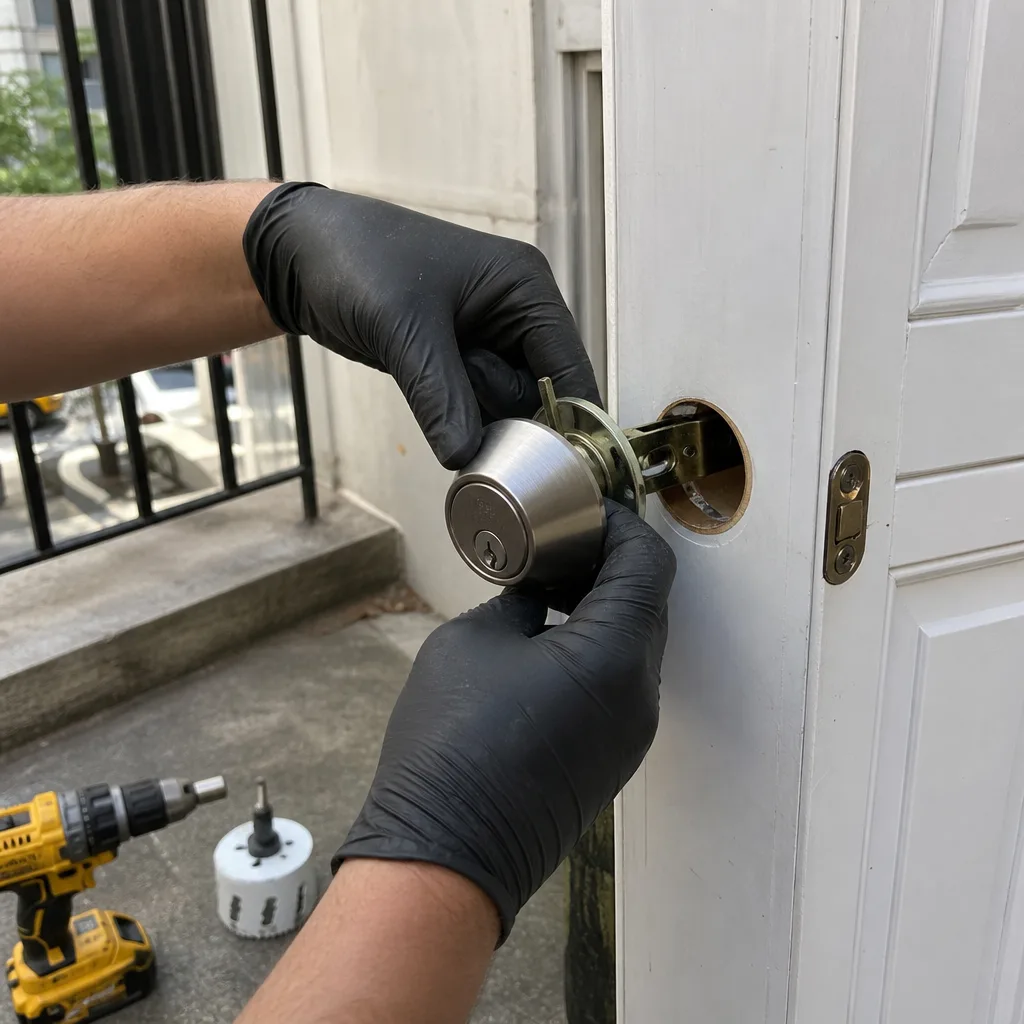
We quote every maintenance engagement in writing before dispatch, per Haven Standard Clause 1. The price on the phone is the price on the invoice. Here are the ranges we see in the Manhattan market:
| Service | Typical Range | What’s Included |
|---|---|---|
| Quarterly high-traffic inspection (1-2 doors) | $180-$280 | Closer test, panic bar inspection, hinge check, lubrication, written report with photos |
| Annual full-building inspection (up to 10 doors) | $450-$750 | All hardware grades, strike alignment, cylinder condition, key operation, documentation |
| Master key system audit | $350-$600 | Key inventory, cylinder inspection, written key schedule, photo record |
| Access control maintenance visit | $320-$550 | Battery test, log review, credential audit, physical cleaning, firmware check |
| Commercial rekey (per cylinder) | $45-$85 | New keys, cylinder repinning, key control registration for high-security |
| Door closer replacement (Grade 1) | $280-$450 | Closer, installation, adjustment, testing, documentation |
| Panic bar repair or replacement | $340-$680 | Diagnosis, parts, installation, code compliance verification |
These are service ranges, not teaser rates. The full price is quoted on the phone before anyone is dispatched, and it is the price on the invoice. There is no call-out surcharge added on arrival.
High-security hardware - Medeco, Mul-T-Lock, Abloy - carries premium pricing but reduces long-term cost through durability and key control. A standard commercial cylinder might need replacement in 3-5 years under heavy use; we’ve serviced Medeco cylinders in Manhattan buildings that have operated for 15+ years with only annual lubrication.
For residential properties in Manhattan, the maintenance schedule and costs differ - see our residential guide for brownstone and co-op specific guidance.
Common Mistakes to Avoid
- Treating commercial hardware like residential. A Kwikset deadbolt rated for residential use will fail in months on a commercial door. The grade marking (ANSI A156.2 Grade 1, 2, or 3) is stamped on the packaging and the lock body. Grade 1 is required for commercial.
- Ignoring the door closer. In Manhattan, a failed closer means a door that doesn’t latch, which means a lock that doesn’t engage, which means a security gap and often a code violation. Closer inspection takes 90 seconds and prevents cascading failures.
- Using WD-40 on locks. It attracts grit and gums up in cold weather. We’ve extracted more locks gummed with WD-40 than with any other cause. Dry graphite or a purpose-formulated lock lubricant only.
- Not rekeying after employee turnover. In Manhattan’s fluid job market, keys walk out regularly. The rekey cost is predictable; the cost of an unauthorized entry is not.
- Relying on verbal maintenance confirmation. “Your guy said it was fine” doesn’t exist in discovery. Insist on dated, photographed, signed documentation for every service.
- Propping fire doors during business hours. It’s common in retail for delivery access. It’s a Class 1 violation, and if fire spreads, it’s criminal negligence. Install a code-compliant hold-open device tied to the alarm system instead.
- Neglecting access control battery backups. They fail silently. Test under load, not with a voltmeter, and replace on a schedule, not on failure.
When to Call a Professional
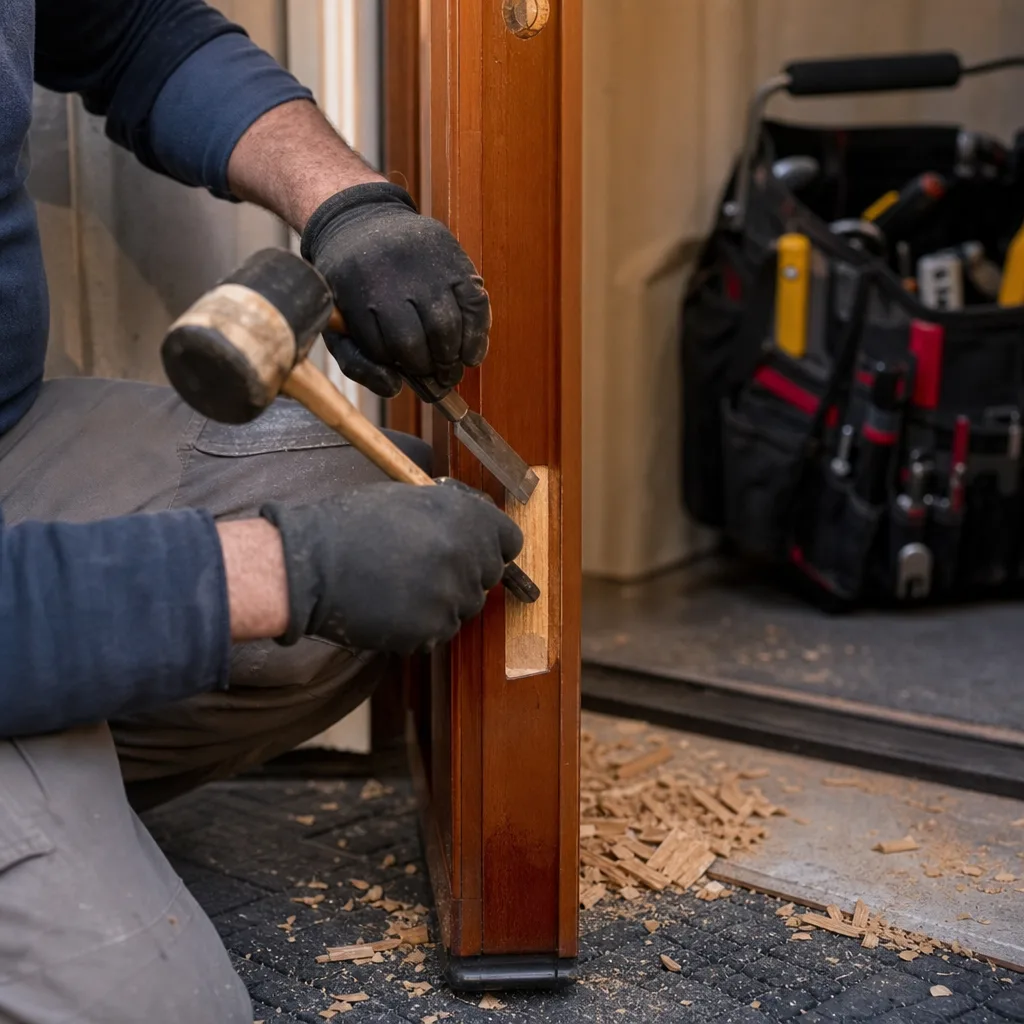
Some maintenance tasks belong to a trained technician with the tools and documentation standards to make the work defensible - a topic we explore in our DIY vs Professional Locksmith guide for Manhattan homeowners. Call a professional when: a panic bar binds or requires more than single-motion release force; a door closer leaks fluid or slams; any key breaks off in a cylinder; an access control panel shows fault codes or loses programming; or you cannot account for all keys in a master key system.
Novak Lock & Security Manhattan offers free estimates for commercial maintenance programs in Manhattan. We’ll inspect your hardware, identify code gaps, and quote a maintenance schedule in writing - no dispatch fee, no obligation. Call (862) 319-3759.
Frequently Asked Questions
Quarterly inspections for high-traffic doors typically run $180-$280, and annual full-building inspections run $450-$750 for up to 10 doors. The exact cost depends on hardware count, grade, and whether access control systems are included. Call (862) 319-3759 for a written estimate - estimates are free.
Yes. Haven Standard Clause 1 prohibits our technicians from changing the quoted price at the door. The price you approve before dispatch is the price on the invoice. This rule has been in place since 2002.
High-traffic panic bars should be inspected quarterly; all panic hardware at least annually. NYC Local Law 26 requires functional panic bars on commercial occupancies with 50+ persons, and FDNY can cite for non-compliance. We test release force, single-motion operation, and key override on every inspection.
Insurers increasingly require dated, photographed maintenance records showing: what was inspected, what condition was found, what service was performed, and who performed it. Verbal confirmation is insufficient. We provide this documentation as standard on every visit, not as an upgrade.
We maintain both. Our technicians are factory-authorized for major access control brands and perform battery backup testing, audit log review, credential management, and firmware updates. See our Access Control Systems in Manhattan page for system-specific capabilities.
ANSI A156.2 Grade 1 is required for commercial use. The grade is stamped on the lock body or packaging. Grade 2 is residential/light commercial; Grade 3 is residential only. We’ve found Grade 2 and 3 hardware on Manhattan commercial doors where a previous owner or handyman substituted cheaper hardware. The wrong grade fails faster and may void insurance coverage.
If any lock installation, rekey, or repair we perform is not done right, we make it right at no charge within 365 days. This applies to workmanship and parts. The promise is documented on every invoice with the specific terms.
The Bottom Line
Commercial lock maintenance in Manhattan is not a residential schedule applied to harder-working hardware. It’s a distinct protocol: quarterly for high-traffic and egress hardware, annual for all else, with specific attention to NYC code requirements, master key accountability, access control battery and log integrity, and documentation that holds up to scrutiny. The businesses that treat maintenance as a scheduled, documented practice avoid the violations, failures, and liability exposure that catch others unprepared. Those that wait for a break-in, a citation, or a system failure pay more and explain more.
Novak Lock & Security Manhattan home
Written by Daniel Novak, Owner at Novak Lock & Security Manhattan, serving Manhattan since 2002. Browse our more guides & resources for additional security insights.